
Old European vs Old Mine Cut: What's the Real Difference?
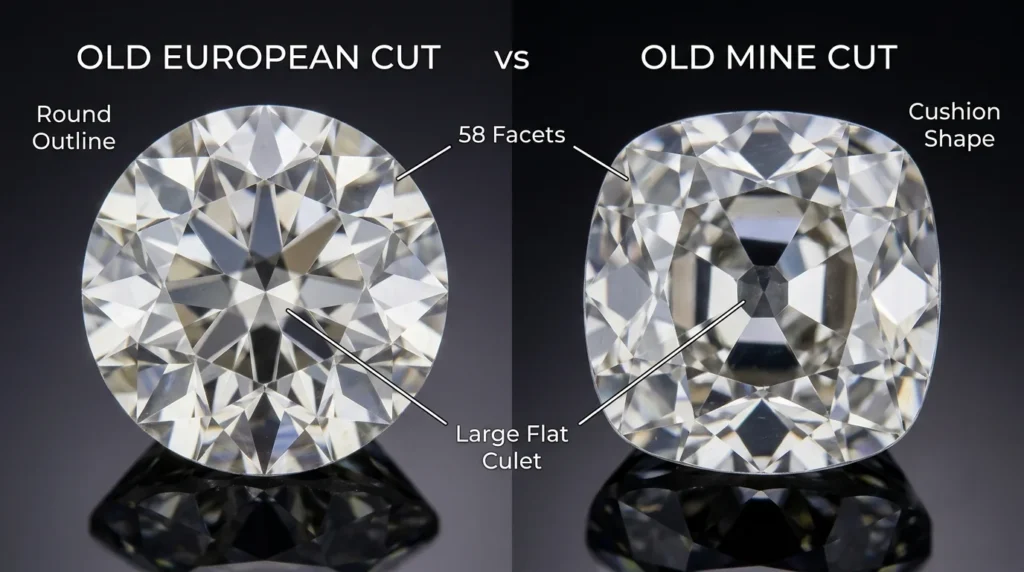
These two antique cuts get confused constantly — even within the trade — because they share real DNA: both are hand-cut, both predate the modern round brilliant, both carry that unmistakable warm, romantic “candlelight” glow instead of sharp modern brilliance. But they’re genuinely different cuts, from different eras, with measurable structural differences. Here’s the precise breakdown.
The Quick Answer
Old Mine Cut (roughly 1700s-1880s) is cushion-shaped — square or rectangular with rounded corners, following the diamond’s natural octahedral rough shape. Old European Cut (roughly 1890s-early 1900s) is round, made possible by the introduction of the bruting machine, which let cutters achieve a circular outline for the first time. Old European is the direct precursor to today’s round brilliant; Old Mine is the direct precursor to today’s cushion cut.
Structural Comparison, Facet by Facet
| Feature | Old Mine Cut | Old European Cut |
|---|---|---|
| Outline | Cushion — square/rectangular, rounded corners | Round |
| Era | ~1700s–1880s (Georgian, early Victorian) | ~1890s–early 1900s (late Victorian, Edwardian) |
| Table Size | Smaller, more closed | Comparatively larger, more open |
| Culet | Large, open — can measure up to 10% of table diameter | Smaller, more centered, but still visibly open |
| Crown | Very high, steep | High, though generally less extreme than Old Mine |
| Symmetry | Irregular — hand-shaped, follows rough crystal form | More refined and uniform — bruting allowed for a rounder outline |
| Facet Count | 58 (chunkier, larger, less uniform) | 58 (more precise, more elongated) |
| Girdle | Thicker, often unpolished | Comparatively more refined |
| Light Performance | Broad, warm flashes — “candlelight brilliance,” fire over brilliance | More brilliance than Old Mine, though still less than modern round brilliant |
The table-size point is worth flagging specifically, since it’s easy to get backwards: Old Mine has the smaller, more closed table of the two — Old European’s table is comparatively larger and more open, part of what nudges its light performance closer to modern brilliance while still retaining that antique character.
Why the Shapes Are So Different
The difference in outline comes down to priorities. Old Mine cutters worked to retain as much weight as possible from the rough diamond’s natural octahedral crystal shape — a cushion-like outline was the practical result of maximizing carat retention over achieving a predetermined geometric ideal. By the time Old European cuts emerged, the bruting machine had made it possible to shape a genuinely round girdle efficiently for the first time, which is why Old European marks the shift toward the standardized proportions that eventually became the modern round brilliant.
Why Both Show More Body Color Than Modern Cuts
Both cuts reveal body color more readily than a modern round brilliant, a direct result of their deep pavilions, large culets, and broad facets — light doesn’t return as crisply white as it does in a modern cut engineered specifically to maximize colorless brilliance. Warmer color grades (roughly J to M on the standard scale) are common in both cuts and were historically set in yellow or rose gold to complement the tone. Collectors and buyers seeking a genuinely period-accurate piece typically embrace this warmth as authentic character rather than something to correct.
Which One Should You Choose for a Restoration or Reproduction Piece
If you’re matching a specific historical piece or reference photo, the outline is your first and most reliable clue — cushion-shaped means Old Mine, while round means Old European. Beyond that, Old Mine suits buyers who want the most pronounced antique character: the warmest, broadest fire and the most visible hand-cut irregularity. Old European suits buyers who want that same romantic quality with a closer approach to modern round brilliance and more refined symmetry. For more specialized restoration or reproduction requirements, explore our Custom & Novelty Shapes options.
OCS Diamond cuts both Old Mine and Old European to accurate historical proportions – see our Specialty & Antique Cuts page for current availability, or contact our team for a custom-matched piece. For jewelry professionals and trade buyers, explore our Trade Program for sourcing support and custom requirements.