
Melee Diamonds 101: How Manufacturers Actually Calculate Stone Count and Cost
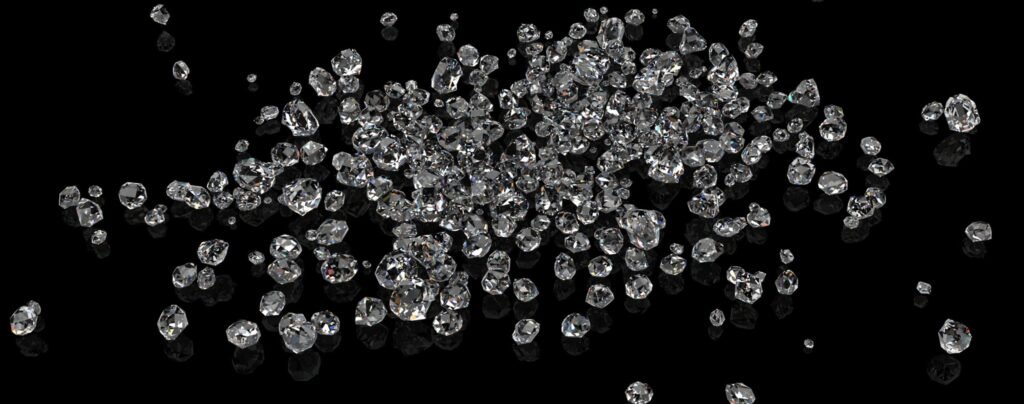
If you’re new to specifying melee for a design, the math isn’t intuitive at first — smaller stones mean more pieces per carat, which changes both your sourcing math and your labor cost in ways that aren’t obvious until you’ve worked through it once. Here’s how it actually breaks down.
Where the Extra Facets Actually Go
| MM Size Range | Approx. Weight / Piece | Common Setting Applications |
|---|---|---|
| 0.8 – 1.0 mm | 0.003 – 0.005 ct | Delicate micro-pavé, watch settings |
| 1.0 – 1.3 mm | 0.005 – 0.01 ct | Fine pavé, thin band designs |
| 1.3 – 1.7 mm | 0.01 – 0.02 ct | Halo settings, standard accent work |
| 1.7 – 2.5 mm | 0.02 – 0.06 ct | Channel settings, more prominent accents |
| 2.5 – 3.8 mm | 0.06 – 0.20 ct | Side stones flanking a center stone |
The Cost Detail Most Buyers Don't Expect
Here’s the one that catches people off guard: for lab-grown melee specifically, the labor cost to set each stone can run three to four times higher than the cost of the stone itself. Drilling a seat, placing the stone, and forming the securing beads takes real bench time regardless of how inexpensive the diamond is — which means your total job cost is driven far more by stone count and setting complexity than by melee price alone.
This has a direct practical implication: when you’re estimating total cost for a design, don’t just price the stones and stop there. A micro-pavé design with 100+ tiny stones will carry meaningfully more labor cost than a design using fewer, slightly larger stones at the same total carat weight — even though the stone cost itself might be similar or even lower for the smaller stones.
Real-World Total Carat Weight, By Setting Type
To ground this in actual numbers: a single pavé band on a standard ring design often runs somewhere around 0.15-0.20 total carats. A fuller halo setting typically runs 0.30-0.40 total carats. A more elaborate multi-row halo can run 0.70-0.80 total carats or more. These are general reference points, not fixed rules — actual requirements depend entirely on your specific design, band width, and stone spacing.
Why Consistency Matters More Than Individual Grading
Unlike a center stone, melee is batch-graded rather than individually assessed — a gemologist reviews the parcel as a whole for consistency rather than grading each stone separately. The actual goal in sourcing melee isn’t finding the single highest-grade stone; it’s ensuring every stone in the parcel matches closely enough that none stands out against its neighbors. One noticeably warmer-toned stone in an otherwise consistent pavé line is a visible flaw, even if that single stone’s individual grade would be perfectly acceptable elsewhere.
What This Means for Your Sourcing Approach
When you’re speccing a design, work backward from total carat weight and stone count together, not stone size alone — the same total carat weight can mean wildly different piece counts (and labor costs) depending on the size you choose. And when evaluating a melee supplier, consistency across the parcel should weigh more heavily in your decision than the specific grade quoted for any single stone. For trade pricing and sourcing support, visit our Trade Program.
Need help calculating stone count for a specific design? Our team can work through the sizing math with you – browse current melee stock or contact us directly with your design specs.